Agentic AI Explained: How AI Takes Action
Learn how agentic AI works, why tools and planning matter, and how to design a simple action-taking agent with clear guardrails.
Agentic AI is one of the most important ideas in modern AI because it moves beyond chat. Instead of only answering questions, an agentic system can plan, choose tools, and take steps to complete a task on a user’s behalf. OpenAI describes agents as systems that can act with a high degree of independence while operating inside defined guardrails, and Anthropic similarly frames agents as models that direct their own processes and tool use to accomplish goals. (cdn.openai.com)
That makes agentic AI a practical trend, not just a buzzword. You will see it in support bots that file tickets, coding assistants that edit files, and research workflows that gather information before drafting an answer. The core idea is simple: the model does not just generate text; it decides what to do next. (anthropic.com)
What agentic AI means
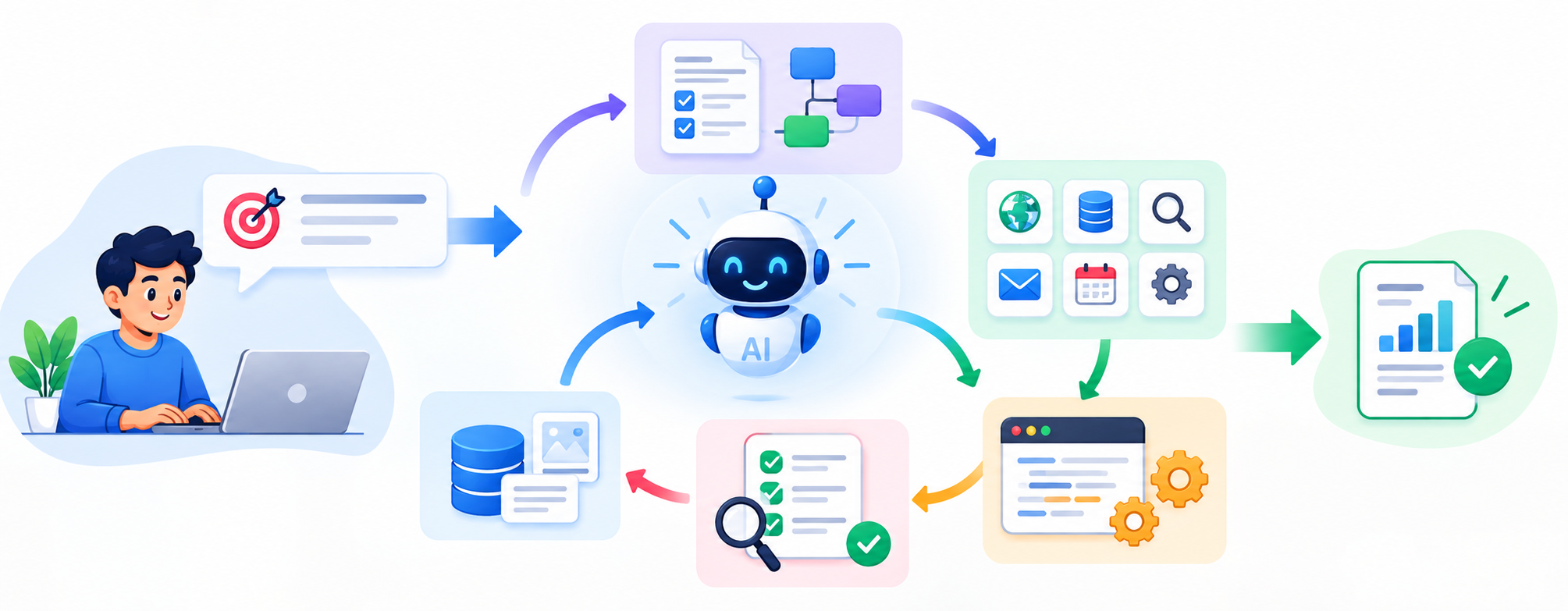
Traditional AI chat is reactive. A user asks a question, and the model replies. Agentic AI adds a control loop: the model interprets a goal, plans a sequence of actions, uses tools, observes results, and then decides whether to continue or stop. OpenAI’s agents guidance notes that this approach can support long-running tasks, tool calling, orchestration, and session state across steps. (developers.openai.com)
In practice, an agent can:
- read a request and break it into steps
- call APIs or internal tools
- store or retrieve context
- check whether the task is complete
- ask for human help when needed
How agentic AI works under the hood
A useful way to understand agentic AI is as a loop with four parts:
- Goal recognition — the system identifies what the user wants.
- Planning — it chooses a strategy or sequence of subtasks.
- Tool use — it calls search, databases, code execution, or business APIs.
- Reflection — it checks outputs, corrects mistakes, and decides the next action.
This is why tool design matters so much. Anthropic emphasizes that tool quality, naming, and scope can strongly affect agent behavior, especially when many tools are available. OpenAI’s agents docs also highlight function calling, MCP support, and hosted tools as the building blocks for action-taking systems. (anthropic.com)
Key building blocks of an agentic system
1. The model. This is the reasoning engine that interprets instructions and decides when to act.
2. Tools. These are the outside capabilities the model can invoke, such as web search, a CRM API, a calendar, or a code runner.
3. Memory or state. The agent needs context across steps, especially for longer workflows. OpenAI’s documentation points to session state and context compaction for this purpose. (developers.openai.com)
4. Guardrails. These are approval rules, limits, and safety checks that keep the agent from taking unsafe or unwanted actions. OpenAI’s practical agent guide stresses clear guardrails, and Anthropic’s framework for trustworthy agents emphasizes safety and reliability. (cdn.openai.com)
5. Observability. Logs and traces help you understand why the agent chose a tool or failed at a step. This becomes essential when you move beyond demos into production. (developers.openai.com)
A simple agentic AI example
The following JavaScript example shows the shape of a tiny agent loop. It is intentionally simplified: a model proposes the next step, a tool runs it, and the agent decides whether to continue. In real systems, you would add authentication, retries, policy checks, and human approval.
(() => {
  const tools = {
    getWeather: async (city) => ({ city, forecast: "Sunny" }),
    createTask: async (title) => ({ id: "task_123", title })
  };

  async function runAgent(goal) {
    const plan = goal.includes("weather")
      ? [{ tool: "getWeather", args: ["Austin"] }]
      : [{ tool: "createTask", args: ["Follow up with customer"] }];

    const results = [];
    for (const step of plan) {
      const output = await tools[step.tool](...step.args);
      results.push({ step, output });
    }

    return {
      goal,
      results,
      status: "completed"
    };
  }

  runAgent("Check the weather and summarize it")
    .then(console.log)
    .catch(console.error);
})();
Even this small pattern captures the spirit of agentic AI: decide, act, observe, repeat. The model is not doing everything by itself; it is orchestrating tools to finish work. (cdn.openai.com)
Where agentic AI is useful
Agentic AI is strongest when tasks are multi-step, partially structured, and dependent on external systems. Common examples include:
- Customer support — look up account data, draft replies, and create tickets
- Engineering — inspect code, run tests, and propose fixes
- Operations — update records, schedule work, and route approvals
- Research — search, compare sources, and summarize findings
Anthropic notes that agents become especially valuable when they can recover from errors, reason about complex inputs, and use tools reliably. That is why agentic systems are often built for workflows, not for open-ended autonomy. (anthropic.com)
Why guardrails matter
Action-taking AI creates new risk. A model that can send messages, change records, or execute code must be constrained. Good guardrails usually include explicit tool permissions, rate limits, human approval for sensitive actions, and audit logs. OpenAI’s agent guidance and Anthropic’s safety framework both emphasize that reliable autonomy depends on bounded control, not unrestricted freedom. (cdn.openai.com)
That is the right mental model for the current generation of agentic AI: powerful, but still supervised. The best systems are not “fully autonomous” in the science-fiction sense. They are carefully designed workflows where AI can take action, but only within rules you trust. (anthropic.com)
How to design a better agent
If you are building with agentic AI, start small:
- define one narrow task
- limit the toolset
- write clear success criteria
- log every tool call
- require approval for risky steps
- test with failure cases, not just happy paths
Anthropic’s engineering guidance points out that thoughtful tool design can reduce complexity and improve reliability, while OpenAI’s agents materials emphasize orchestration, context management, and the practical value of starting with a simple workflow before scaling up. (anthropic.com)

Conclusion
Agentic AI is about turning intelligence into action. The important shift is not just better answers, but better execution: planning, calling tools, handling state, and respecting guardrails. If you are learning the trend, focus on these four ideas first: tool use, planning, memory, and supervision. Those are the foundations that make agentic AI useful in real products today. (developers.openai.com)
Related field notes
Mastering AI Image Generation Shortcuts for Faster Creative Workflows
Discover essential AI image generation shortcuts like /exploadview, /zoom, and /aerialview to speed up chatbot-based AI art creation. Learn how to use these commands effectively with examples.
AI & Machine Learning · 7 min readPrompt Guide: Mastering Effective Prompts for ChatGPT, Gemini, and More
This practical prompt guide explores techniques to craft clear and effective prompts for ChatGPT, Gemini, and similar AI models, helping you get the best responses every time.
AI & Machine Learning · 2 min readTop 10 AI Tools in September 2026 Transforming Technology
Explore the latest AI tools in September 2026 that are reshaping industries with advanced capabilities in automation, creativity, and data analysis.